Waterfilling & Rounding
When a round clears, e_i must be computed for every participating address such that no address exceeds either its own deposit or the global cap, and the sum of all effective contributions equals V_target exactly.
Two Regimes
Fast Path
If, after applying a single global scaling factor k, no address would be pushed above A_max, the fill is a pure linear scale:
e_i = z_i × k_global , k_global = V_target / Σ_i z_i
Iterative Path
If one or more addresses would be capped under a single global k, those addresses are pinned at e_i = A_max and removed from both the remaining funding pool and the remaining participant set. k is then recomputed over the reduced problem. This repeats until no further address is pinned — that is, until convergence.
Every intermediate and final value obeys the three-way clamp:
e_i = min( z_i × k , A_max , z_i )
Simultaneously forbids allocating more than an address deposited, allocating more than the per-address cap, and any negative refund — since refund_i = z_i − e_i ≥ 0 follows directly.
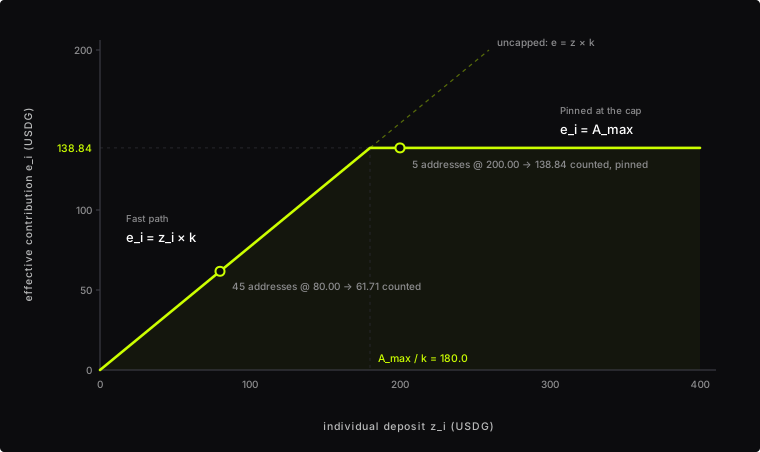
Fig. 03 · The fill function e_i(z_i), plotted at the worked example's own values — k = 0.77133, A_max = 138.84. Below the threshold A_max / k contribution scales linearly with deposit; above it, addresses are pinned at the cap and the freed allocation is redistributed by recomputing k over the remaining uncapped set.
Largest-Remainder Rounding
e_i and token_i are computed over finite-precision integers. Direct division introduces truncation error that, summed across potentially thousands of addresses, must not silently violate conservation.
- Compute every
e_iandtoken_iby flooring. - Compute the residual — the difference between the target sum and the sum of floored values — in the USDG and token dimensions independently.
- Distribute the residual one minimum unit at a time to the addresses with the largest fractional remainder, in descending order of remainder size.
- Break ties by ascending address order, giving a total order and therefore a unique, reproducible outcome for any given input set.
This guarantees the two settlement identities hold exactly, not approximately:
Σ_i e_i = V_target Σ_i token_i = tokenPool
Why step 4 matters
Deterministic tie-breaking is what makes settlement reproducible by anyone. Given the frozen deposit set there is exactly one valid output — so a third party can recompute the Merkle root independently and verify the published one matches.