Worked Examples
Both use the current parameters — FDV = 6,942 USDG, A_max = 138.84 USDG, R_raise = 50%, so V_target = 3,471 USDG.
Example 1 — Mixed Deposits, Iterative Path
Input: 5 addresses deposit 200 USDG each; 45 addresses deposit 80 USDG each.
Total deposits are 5 × 200 + 45 × 80 = 4,600 USDG. Reachable demand is 5 × 138.84 + 45 × 80 = 4,294.2 USDG, comfortably above the 3,471 target — the round clears.
Because A_max = 138.84 < 200, a single global k would push the five large addresses above the cap. So:
- The 5 large addresses are pinned at
e_i = 138.84, contributing 694.2 USDG in total, and are removed from the problem. kis recomputed over the remaining 45 addresses alone against the remaining3,471 − 694.2 = 2,776.8USDG.k = 2,776.8 / (45 × 80) = 0.77133. No address is pushed above the cap, so the loop converges.
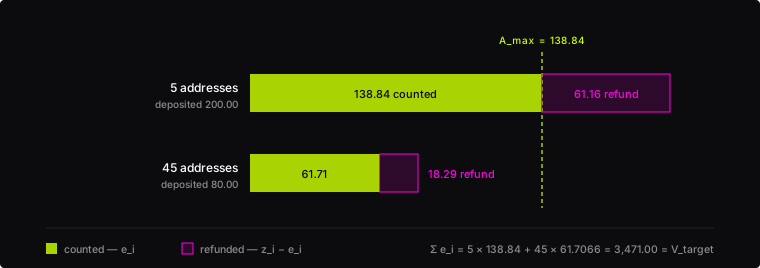
Fig. 04 · The five large addresses are capped, so their excess is refunded. The forty-five smaller ones are never capped — their refund comes from proportional scaling, not from the ceiling.
| Group | Deposit z_i | Effective e_i | Refund |
|---|---|---|---|
| 5 addresses | 200.00 | 138.84 pinned | 61.16 |
| 45 addresses | 80.00 | 61.7066 | 18.2934 |
This shows both properties at once: a subset of addresses can be capped while the rest still resolve by simple proportional scaling, and the largest-remainder step — not floor truncation — determines the final integer allocation.
Example 2 — The Boundary at N_min
Input: N addresses, each depositing far in excess of A_max, so every address is pinned at the cap.
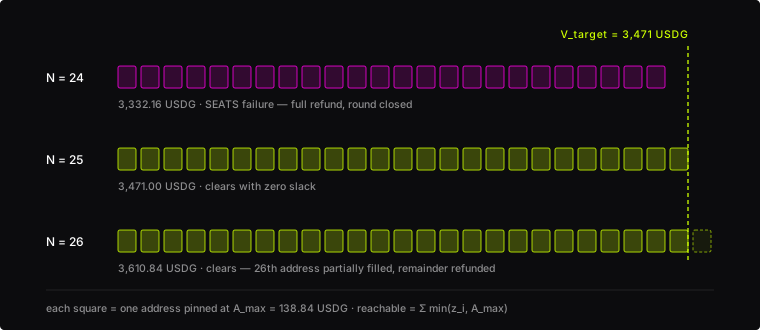
Fig. 05 · Twenty-four maximally-funded addresses cannot clear this round — they may hold unbounded capital between them and still fall short, because reachable counts capped contributions, not deposits.
| N | reachable | Outcome |
|---|---|---|
| 24 | 3,332.16 < 3,471 | SEATS failure. Full refund to all 24. No LP. |
| 25 | 3,471.00 = 3,471 | Clears with zero slack. Every unit of reachable demand is consumed. |
| 26 | 3,610.84 > 3,471 | Clears. The marginal address receives a partial fill via the largest-remainder step; the remainder is refunded. |
No hidden buffer
N = 25 clearing at exactly zero slack confirms there is no minimum over-subscription buffer in the mechanism beyond what the arithmetic itself requires. The contract does not quietly demand 101% of target.